

The Health Disparities Podcast is the world’s leading health equity discussion forum and is a program of Movement is Life. This podcast features thought leaders in the world of equitable health, and highlights health disparities, social determinants of health and community-led solutions.
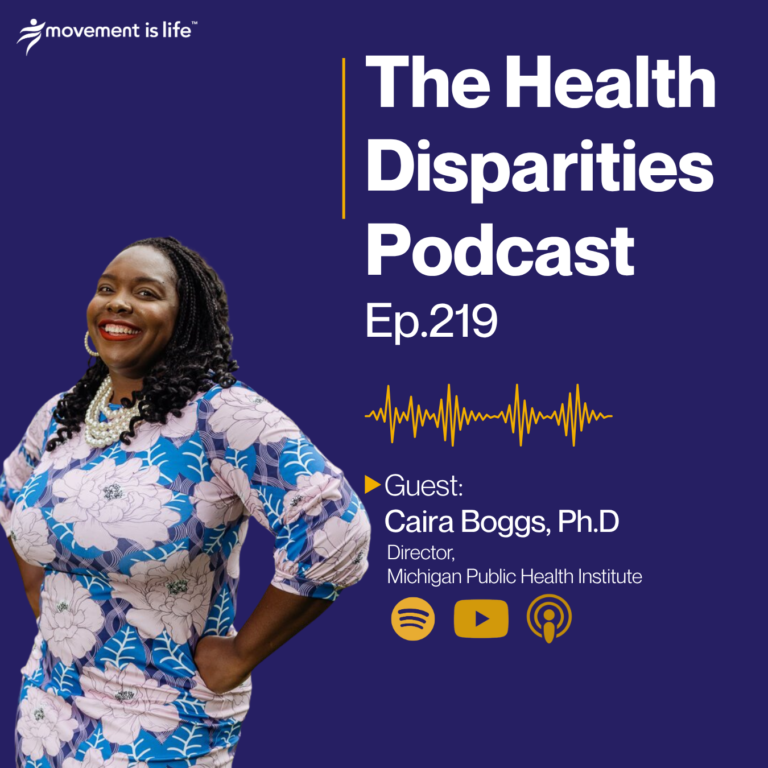
In this episode of The Health Disparities Podcast, host Ber‑Henda Williams sits down with Dr. Caira Boggs, Director of the Michigan Public Health Institute’s Center for Health Innovation and Practice and Detroit Health Initiatives. A proud Detroit native and Detroit Public Schools graduate, Dr. Boggs leads 16 initiatives focused on health equity, recovery, food access, chronic disease prevention, and community‑led grantmaking — all grounded in the lived experiences of Detroit neighborhoods.
Dr. Boggs shares the early moments that shaped her understanding of inequity, from growing up in a deeply connected Detroit community to witnessing stark disparities when she left home for college. Her path from kinesiology and pre‑med to public health leadership was fueled by a desire to advocate for people who look like her — especially after learning how maternal and infant health outcomes disproportionately impact Black women, regardless of income or education.
Together, Ber‑Henda and Dr. Boggs explore:
- What resilience looks like in Detroit neighborhoods, where communities “keep going, keep moving, no matter what,” despite redlining, food insecurity, and structural barriers.
- How Detroit schools and neighborhood roots shaped Dr. Caira’s public health lens.
- Worker health realities in Detroit’s plants — from blood pressure to chronic disease risks.
- What recovery‑friendly workplaces need: Narcan access, dignity, and long‑term support.
- Food insecurity as both structural and neighbor‑to‑neighbor — and how small acts help.
- Neighborhood‑driven solutions like micro‑grants, walking clubs, and anchor organizations.
- How COVID‑19 exposed inequities and elevated social determinants of health.
Dr. Boggs also reflects on the personal experiences that continue to motivate her — from loved ones whose health outcomes could have been different with better access, to the collective trauma and awakening brought on by the pandemic. Her message is clear: every person has the power to change someone’s trajectory, whether through advocacy, compassion, or simply knowing the people on your block.
This episode is essential listening for anyone working in community health, public health, philanthropy, health equity, or systems‑level change — and for anyone who believes in the strength and brilliance of Detroit’s neighborhoods.